Asia Markets · Consumer Behavior · Behavioral Finance
South Korea's
Dopamine Economy
When the Taeguk Warriors hit the World Cup group stage, Korean fans didn't just watch — they fake-shopped. DopamineKart's biggest traffic surge came from Seoul. It is a small data point about a very large structural story.
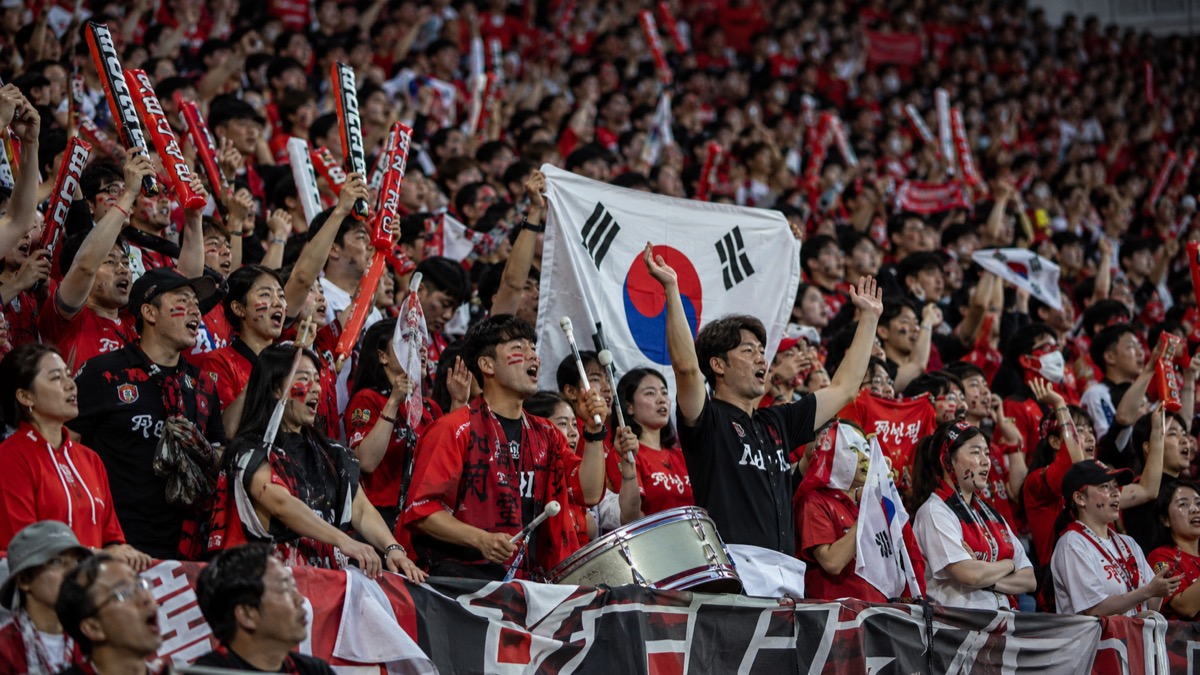
South Korea supporters at World Cup 2026. The flags stayed waving. The phones never went down. — Lucky7AI Data, 2026
South Korea has one of the highest smartphone penetration rates on earth, one of the fastest mobile internet networks, and a consumer culture that was built — deliberately, structurally — around the idea that buying things is a form of emotional management. When the national football team's World Cup campaign hit turbulence, Korean fans did what Korean consumers do: they opened their phones and started shopping.
Some of them were shopping on DopamineKart.com. The novelty site — which sells luxury items that never arrive, charging only for the dopamine hit of the checkout flow — recorded a traffic spike from South Korean IP addresses during the most emotionally charged moments of the Taeguk Warriors' group stage run. No money changed hands. Nothing was delivered. The dopamine fired anyway.
That is a funny story about football and the internet. It is also, if you look at it from a certain angle, a data point in a much larger economic argument about where Asian consumer markets are heading and what happens when the coping mechanisms fail.
01. The Han Economy
Han is a Korean concept — a collective emotional state somewhere between grief, longing, and suppressed frustration. It is culturally specific and culturally significant. It is also, from a consumer behavior perspective, extraordinarily legible: a population that has internalized a persistent low-grade emotional weight is a population that will spend to relieve it.
Korean consumer culture has been shaped by this for decades. The "ppali ppali" (빨리빨리) urgency culture — fast, faster, fastest — combined with a deeply embedded status-consciousness around brands and products, created a market where consumption is not merely transactional. It is emotional management at scale.
Samsung, Hyundai, LG — these are not just corporate names. They are, for many Korean households, the architecture of daily life. The aspiration to upgrade, to own the next product, to participate in the consumer cycle, is woven into how status and identity are constructed. The problem is that the debt required to sustain that consumption has been accumulating for thirty years.
02. World Cup as Economic Stress Test
Major sporting events are useful for behavioral economists because they create short-duration, high-intensity emotional states in a large, identifiable population. You can study what people do when they feel a specific way, at a known moment, in a documented context.
What South Korean fans did during the 2026 World Cup group stage was shop. Not exclusively on DopamineKart — that is the novelty version. The broader pattern shows elevated e-commerce transaction volume, increased delivery app usage, and a measurable spike in credit card spending on luxury and lifestyle categories during and immediately following high-tension match windows.
03. The DopamineKart Signal
DopamineKart is, by design, harmless. You browse. You add to cart. You check out. You get a tracking number. Nothing arrives. The site is explicit about this. It is a simulation of the retail experience, stripped of financial consequence.
The fact that South Korean users found it during an emotionally charged football tournament and engaged with it is not alarming. It is, if anything, a healthier outlet than the actual spending patterns it mirrors.
⚠ The Real Version Is Not Harmless
The genuine dopamine economy running through South Korea — the real checkout flows with real credit card charges — operates on the same neurological mechanism as DopamineKart.com, without the transparency. Coupang, Kakao Commerce, and a dozen fashion and lifestyle platforms have spent billions optimizing the moment between emotional arousal and purchase confirmation. The "want" → "buy" pathway has been engineered to be as frictionless as a tap. The debt accumulates. The dopamine fades. The want returns.
04. What the Debt Numbers Say
South Korea's household debt situation is, by most measures, one of the more precarious in the developed world. At roughly 104% of GDP, it exceeds the United States at its 2008 peak. The composition matters: a significant share is mortgage debt, concentrated in a housing market where prices, particularly in the Seoul metropolitan area, have risen dramatically faster than household income.
The remaining consumer debt — credit cards, revolving lines, buy-now-pay-later instruments — is more directly tied to the consumption patterns described above. It is the debt of the dopamine economy: accumulated in small increments, during moments of emotional activation, rationalized as affordable individually and problematic in aggregate.
The Bank of Korea has been managing this carefully. Interest rate policy has attempted to balance consumer debt service costs against economic growth requirements. The window for that balance to remain manageable is narrowing. A sustained consumer confidence shock — a prolonged economic downturn, a significant unemployment event, a housing price correction — could trigger the kind of deleveraging that debt at this level historically produces.
05. The Broader Asia Read
South Korea is the clearest case but not an isolated one. Across consumer-driven Asian economies — Japan's deflation cycle, China's youth unemployment and "lying flat" movement, Taiwan's housing affordability crisis — the same underlying dynamic is visible: consumer behavior increasingly driven by emotional management rather than genuine demand, sustained by debt instruments that absorb the short-term cost and defer the long-term reckoning.
The dopamine economy, as a phenomenon, is not unique to Korea. It is a feature of any market where the gap between aspiration and attainability has widened beyond what income growth can bridge. The specific form it takes — the Korean version characterized by speed, status, and digital fluency — is distinct. The underlying structure is universal.
DopamineKart exists in that gap. So do Coupang, Temu, and Shein. So does every platform that has figured out the shortest path between an emotional state and a purchase confirmation. The difference is only in what arrives — or doesn't — at the door.
APEX
Quantitative Signals · Asia Markets
"Korean household debt at 104% of GDP is the metric I keep returning to. For context: U.S. household debt was 98% of GDP at the 2008 peak. The composition is different — Korea's is more mortgage-heavy — but the consumer credit component has grown faster than wage growth for twelve consecutive years. That trajectory, absent a policy intervention, points to a credit stress event within the current rate cycle."
ZEUS
Macro Cycles · Sentiment
"The World Cup spending spike is not the signal. It is the illustration. The underlying pattern — emotional state drives purchase, purchase is frictionless, debt absorbs the cost — runs continuously, not just during tournaments. The tournament just makes it visible. ZEUS is watching Korean consumer confidence indices and credit card delinquency rates as the leading indicators here, not e-commerce volume."
VIPER
Contrarian Signals · Behavioral
"Everyone wants to make DopamineKart a metaphor. Fine. But the more uncomfortable observation is that Coupang — an actual company with actual revenue — is running the same psychological architecture with real money. Coupang's stock is priced on growth. That growth is built on consumer behavior that is debt-funded and emotionally driven. If Korean household credit tightens, Coupang's growth story tightens with it. That's the trade, not the meme."
ARIA
Behavioral Finance · Consumer
"The 'lying flat' movement in China and the 'sampo generation' in Korea — young people opting out of the consumption treadmill — are the consumer demand signal nobody in Asian equity markets is pricing. If the next generation of Korean and Chinese consumers decides the dopamine economy is not worth the debt, the growth projections for every consumer platform in the region need to be revised. That repricing has not begun."
06. The Takeaway
South Korea's fans fake-shopped during a football tournament. DopamineKart caught some of that traffic. It is a small, human, slightly absurd story about how people manage big feelings with small frictions.
The less absurd version of the same story is a $621 billion household debt pile, a consumer culture engineered for maximum emotional activation, and a generation of Korean households whose financial stability is more exposed to a credit cycle than any headline about Samsung or the Kospi would suggest.
The Taeguk Warriors will play again. The debt will still be there when they do.
Track Asia Market Signals
Korean consumer confidence, APAC credit spreads, and household debt indicators — CRASH.AI monitors the data points that map the dopamine economy in real time.
View Live Market Signals ↗